
Table of Contents
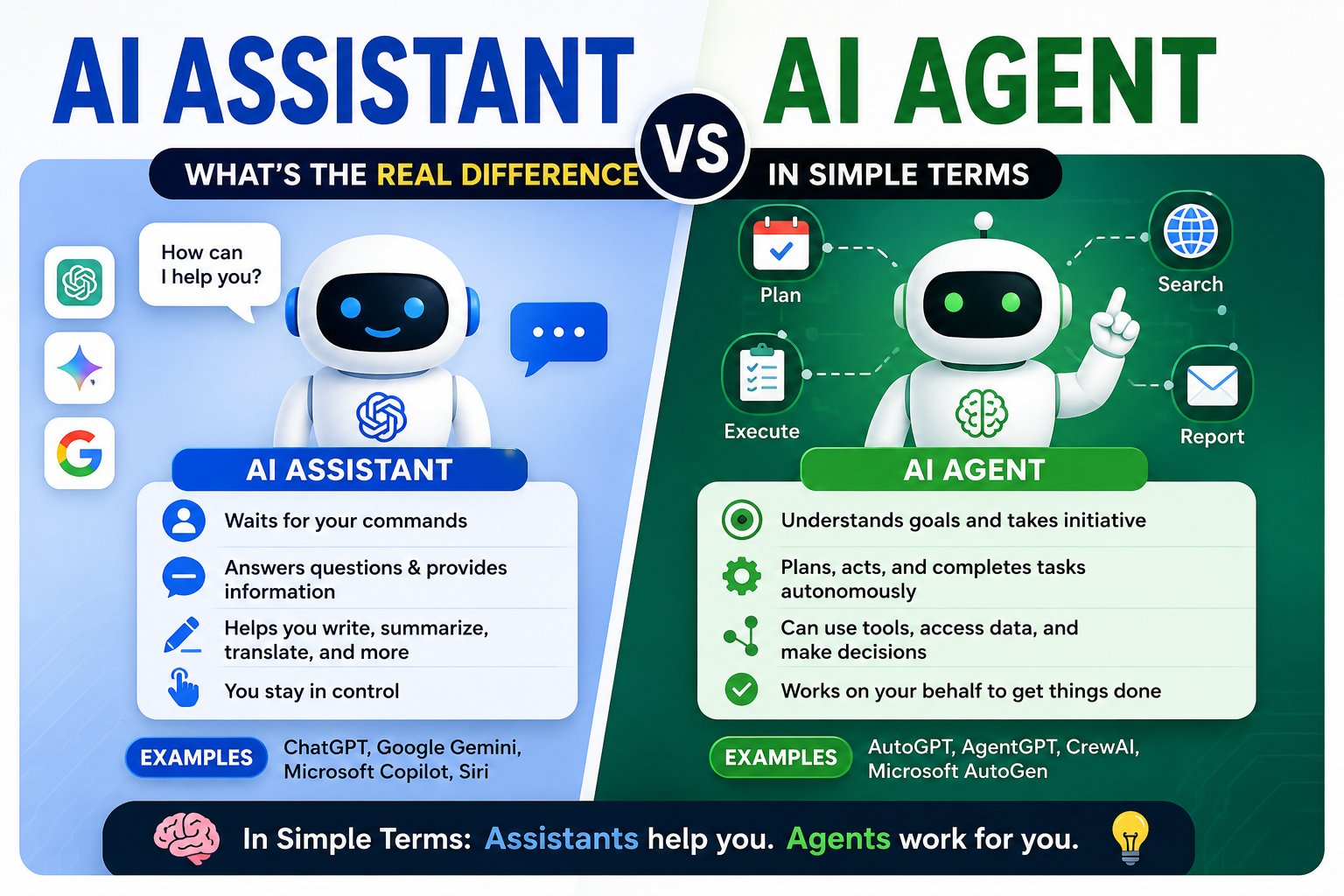
ToggleAI Assistant vs AI Agent
AI is one of those things that’s quietly becoming part of everything we do. You open your laptop, your phone, even some apps and suddenly AI is just… there.
Two terms that keep coming up a lot these days are AI assistants and AI agents.
At first, most people don’t really separate them. Even in casual conversations, they get mixed up like they mean the same thing. But they don’t. And once you actually see them in action, the difference feels pretty obvious.
It mostly comes down to one thing, how much the AI depends on you while doing the work.
So, what exactly is an AI assistant?
An AI assistant is basically what most people already use every day without overthinking it.
It’s reactive. You say something, it responds. Then it waits again.
Nothing continues unless you trigger it.
Tools like ChatGPT, Siri, Google Assistant, Alexa, and Microsoft Copilot fall into this category.
But instead of thinking in tool names, think in behavior.
You open your laptop five minutes before a meeting and quickly ask:
“Summarize this report in simple points.”
It does that. You read it. Maybe you ask it to make it shorter. Or change the tone a bit.
And that’s the entire loop.
You’re still steering everything.
I’ve seen this pattern a lot in offices too, someone is basically just using AI like a fast drafting tool. Not automation, more like “help me finish this faster.”
Even students do the same thing. They don’t really “use AI systems” in a complex way, they just keep asking small questions one after another.
And honestly, that’s what makes assistants comfortable. You never lose control.
Now AI agents feel a bit different… in a noticeable way
This is where things start to shift.
An AI agent doesn’t just respond. It tries to complete something.
Instead of waiting for every step, it works through a goal in chunks, kind of like it has its own mini plan.
And this is where people usually go, “Okay… this feels different.”
Let’s take a simple situation.
Say a manager gives this instruction:
“Prepare a competitor analysis for our product and send me a report.”
With an assistant, the process is still broken into pieces:
you ask for competitors, then pricing, then comparisons, then you compile everything yourself.
With an AI agent, the expectation is different.
It might quietly go off and:
- gather competitor data
- check pricing patterns
- compare features
- structure everything
- then generate a full report
And you don’t sit there guiding every step.
You mostly just wait for the output.
That’s the shift, less “helping you do it” and more “trying to finish it.”
The easiest way to understand it (no technical talk)
Honestly, the simplest way I’ve heard it described is this:
An AI assistant is like someone you keep asking for small help throughout the task.
An AI agent is more like handing someone a task and saying, “Just get this done and update me later.”
Not perfect control. Not full independence either. Somewhere in between.
And that “in-between” is where most of the current AI tools are heading.
Real situations make the difference very obvious
Let’s take something normal like writing emails.
With an AI assistant, you usually go step by step.
You ask for a draft, then maybe adjust tone, then fix a line, then tweak it again. It feels like back-and-forth editing.
Nothing wrong with that. It’s actually how most people use AI today.
Now imagine a more agent-style system.
You just say:
“Handle my client follow-ups for today.”
And instead of waiting for instructions every time, it might:
check messages, draft replies, sort urgency, and prepare responses.
You’re not actively driving each step anymore.
You’re more like a reviewer at the end.
Same with students too, assistants help them learn piece by piece, but an agent-style system would basically prepare structured notes, quizzes, summaries all together.
It almost feels like the workload shifts direction.
Why people still prefer AI assistants (this part is important)
Even though AI agents sound powerful, most people don’t actually want full automation in everything.
And that makes sense.
There’s something reassuring about seeing every step.
In real work environments, people still like to check things before sending them out, emails, reports, even small summaries.
It’s not about distrust in AI. It’s just habit. And sometimes caution.
Assistants fit that mindset better because nothing happens without approval.
Why companies are still excited about AI agents
On the other side, businesses see something different.
A lot of office work is repetitive. Not hard, just time-consuming.
Writing similar emails. Making weekly reports. Updating spreadsheets. Following up with customers.
An AI agent, in theory, reduces a lot of that repetition.
So instead of:
“do step 1 → then step 2 → then step 3”
you just say:
“handle this workflow”
That’s why companies are experimenting with it so aggressively.
But there’s also hesitation. Because once systems start making decisions on their own, even small mistakes can scale fast.
A simple way people explain it in real life
I’ve heard this comparison a few times, and it actually fits well:
Using an AI assistant feels like messaging a coworker for quick help throughout your task.
Using an AI agent feels more like assigning work to someone and checking back when it’s done.
You’re still involved in both cases, just at different levels.
So where does this actually lead?
Right now, AI assistants are everywhere. Most people already use them without even labeling them as “AI tools.”
AI agents are still developing, but they’re clearly the direction things are moving toward.
Not replacing assistants. More like building on top of them.
And maybe that’s the real point here, it’s not assistant vs agent as a fight.
It’s more like a gradual shift from:
“help me do this” to “handle this for me”
Final thought
If you strip away all the technical definitions, the difference is actually pretty simple.
An AI assistant waits for you.
An AI agent tries to move without needing you at every step.
And the interesting part is, we’re still in the middle of figuring out how far we actually want that independence to go.
Because convenience is great… until you realize you’re no longer holding every step in your hands.
FAQs: AI Assistant vs AI Agent
What is the main difference between an AI assistant and an AI agent?
An AI assistant responds to user instructions and completes tasks step by step, while an AI agent can work toward a goal more independently with minimal user input.
Can AI agents work without human input?
AI agents can perform certain tasks with reduced human input, but they still require initial setup, goals, and monitoring in most real-world applications.
Which is better: AI assistant or AI agent?
Neither is better universally. AI assistants are best for controlled, step-by-step tasks, while AI agents are better for automation and multi-step workflows.
Where are AI assistants commonly used?
AI assistants are commonly used in writing, coding help, answering questions, setting reminders, customer support, and everyday productivity tasks.
Where are AI agents used in real life?
AI agents are used in areas like workflow automation, customer service systems, data processing, business reporting, and AI-based decision support systems.
4 thoughts on “AI Assistant vs AI Agent: What’s the Real Difference?”