Table of Contents
ToggleIntroduction
Most people do not struggle with time because they have too little of it.
They struggle because too many things compete for their attention at the same time.
A typical day often starts with good intentions. You sit down with a clear plan, determined to finish an important task. Then an email arrives. A message notification appears. Someone requests a quick meeting. Before long, hours have passed, and the task that seemed like the top priority in the morning remains unfinished.
This experience is incredibly common.
In today’s fast-moving world, effective time management is no longer just a useful skill. It has become essential for reducing stress, staying productive, and maintaining a healthy balance between work and personal life.
The good news is that time management is not about working longer hours or filling every minute with activity. It is about making better decisions about how you spend your time.
Why Time Management Matters More Than Ever
Modern life is filled with distractions.
Most professionals are expected to manage emails, meetings, deadlines, messages, projects, and personal responsibilities simultaneously. Technology has made communication faster, but it has also created more interruptions than previous generations experienced.
Many people finish their day feeling exhausted even when they have not completed their most important work.
The problem is not always a lack of effort.
Often, it is a lack of direction.
Good time management helps you focus on tasks that truly matter rather than simply reacting to whatever demands your attention first. It allows you to work with greater purpose instead of constantly feeling busy.
People who manage their time well often experience lower stress levels, better work-life balance, and greater progress toward long-term goals.
Modern workplace research shows that employees spend a significant amount of their day responding to emails, meetings, and messages.
Understanding How Time Really Gets Lost
When people think about poor time management, they often imagine laziness or procrastination.
In reality, time is usually lost in much smaller ways.
Checking social media for five minutes.
Responding to an email that could have waited.
Switching between multiple tasks.
Attending unnecessary meetings.
Constantly reacting to notifications.
Individually, these activities seem harmless.
Together, they can consume several hours each day.
One of the biggest productivity challenges today is context switching. Every time your attention moves from one task to another, your brain needs time to refocus. Even short interruptions can reduce concentration and make important work take much longer than expected.
Understanding where your time actually goes is often the first step toward managing it better.
Start with Clear Priorities
One of the simplest ways to improve productivity is to become more selective about what deserves your attention.
Not every task carries the same level of importance.
Successful professionals often begin their day by identifying the few activities that will have the greatest impact. Instead of creating long to-do lists filled with dozens of tasks, they focus on the work that moves them closer to their goals.
The Eisenhower Matrix remains one of the most useful frameworks for this purpose.
It encourages people to separate tasks into four categories:
- Important and urgent
- Important but not urgent
- Urgent but not important
- Neither urgent nor important
This simple approach helps prevent people from spending their entire day reacting to low-value activities.
Why Time Blocking Works So Well
Many people start their day asking themselves what they should work on next.
That constant decision-making consumes energy.
Time blocking removes much of that uncertainty.
Instead of deciding throughout the day, you schedule dedicated periods for specific activities in advance.
For example, you might reserve the morning for deep work, set aside time after lunch for meetings, and dedicate the final hour of the day to emails and administrative tasks.
This approach creates structure and reduces the temptation to multitask.
Many successful entrepreneurs, executives, and creators rely on time blocking because it protects their most productive hours from distractions.
The Problem with Multitasking
Multitasking often feels productive.
In reality, it usually creates the opposite effect.
Answering emails while attending a meeting, checking messages while writing a report, or switching between several projects at once may create the impression of efficiency.
However, research consistently shows that multitasking reduces focus and increases mistakes.
People tend to produce better results when they give their full attention to one task at a time.
Deep concentration remains one of the most valuable skills in an increasingly distracted world.
Technology Can Help Or Hurt
Technology is a powerful tool, but it can easily become a source of distraction.
Many productivity apps promise better organization, improved focus, and greater efficiency.
Some genuinely help.
Tools such as Trello, Notion, Google Calendar, and Pomodoro timers can make planning and tracking tasks much easier.
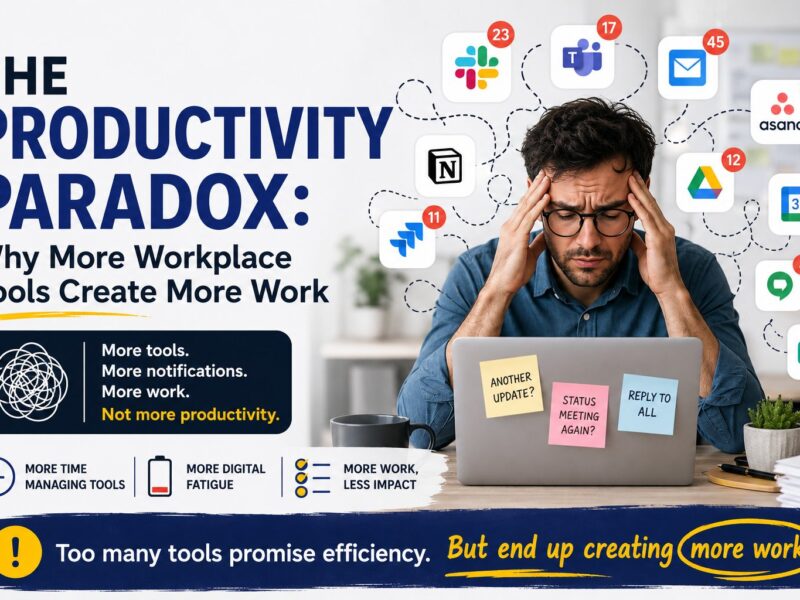
However, there is also a growing trend where people spend more time managing productivity systems than actually completing work.
Having ten productivity apps does not automatically make someone productive.
Sometimes the simplest system is the most effective.
Many organizations discover that adding more productivity tools does not always lead to better results.
The goal should always be to support your workflow rather than complicate it.
How AI Is Changing Time Management
Artificial intelligence is beginning to play a larger role in productivity.
AI assistants can now summarize meetings, organize schedules, draft emails, and automate repetitive tasks.
For many professionals, these tools save valuable time each week.
At the same time, AI is not a magic solution.
Some organizations continue adding new tools without simplifying existing workflows. As a result, employees may end up managing more systems rather than fewer.
As AI tools become more common in workplaces, discussions around responsible AI use continue to grow.
Modern AI systems are also becoming better at remembering user preferences and work habits.
The most productive people use technology strategically. They allow tools to handle repetitive work while keeping their attention focused on high-value activities that require human judgment and creativity.
Overcoming Procrastination
Almost everyone procrastinates occasionally.
The mistake many people make is assuming procrastination comes from laziness.
More often, it comes from feeling overwhelmed.
Large projects can feel intimidating because the finish line appears far away.
A simple solution is to focus on the next step rather than the entire task.
Instead of saying:
“Finish the report.”
Try:
“Write the introduction.”
Small actions create momentum. Once work begins, continuing often becomes much easier.
Real-Life Examples of Better Time Management
Consider Sarah, a freelance designer who constantly felt stressed despite working long hours.
After tracking her schedule for one week, she discovered that frequent interruptions were destroying her focus. By grouping client communication into specific time blocks, she gained several additional hours of productive work each week.
David, a project manager, faced a different challenge. His days were filled with meetings, leaving little time for strategic planning. By evaluating which meetings truly required his presence, he reduced unnecessary commitments and regained control of his schedule.
Emily, a university student, struggled to stay focused while studying. After adopting the Pomodoro Technique, she found it easier to maintain concentration without feeling mentally exhausted.
These examples highlight an important truth.
Better time management is rarely about working harder.
It is usually about working more intentionally.
Building Long-Term Time Management Habits
Improving time management is not a one-time event.
It is an ongoing process.
Even the most productive people regularly review their schedules, adjust priorities, and refine their routines.
Small habits often produce the biggest results.
Planning tomorrow before leaving work.
Reviewing weekly goals.
Limiting distractions.
Protecting focused work time.
These actions may seem minor, but over months and years they create significant improvements.
Consistency matters far more than perfection.
Final Thoughts
Mastering time management is not about squeezing more tasks into every hour.
It is about making sure your time is spent on the things that matter most.
In a world filled with notifications, meetings, distractions, and endless digital tools, attention has become one of our most valuable resources.
The people who learn to protect that attention gain a significant advantage.
They experience less stress, make better progress toward their goals, and create more space for both professional success and personal well-being.
Time is the one resource that cannot be replaced.
Learning how to manage it effectively may be one of the most valuable investments you ever make.
FAQ Section
What is time management?
Time management is the process of planning and organizing how you spend your time to complete tasks more efficiently. Good time management helps improve productivity, reduce stress, and create a better work-life balance.
What are the benefits of good time management?
Effective time management offers several benefits, including:
- Increased productivity
- Reduced stress
- Better focus and concentration
- Improved work-life balance
- Greater goal achievement
- More free time for personal activities
How can I improve my time management skills?
You can improve your time management skills by setting clear goals, prioritizing important tasks, creating daily schedules, minimizing distractions, and regularly reviewing how you spend your time.
Does multitasking improve productivity?
No. Research shows that multitasking often reduces productivity because switching between tasks makes it harder to maintain focus. Concentrating on one task at a time usually leads to better results and fewer mistakes.
How does AI help with time management?
AI can help with time management by automating routine tasks, organizing schedules, summarizing meetings, drafting emails, and providing productivity insights. When used correctly, AI tools can save valuable time and improve efficiency.