
Artificial Intelligence has become part of everyday life much faster than many people expected.
A few years ago, digital assistants were mostly limited to simple tasks. You could ask about the weather, set an alarm, or get a quick answer to a basic question. They were useful, but nobody would have described them as particularly smart.
Today, things feel very different.
People use AI assistants to draft emails, summarize reports, organize schedules, generate content, brainstorm ideas, and even help with complex work projects. In many workplaces, AI tools have quietly become part of daily routines.
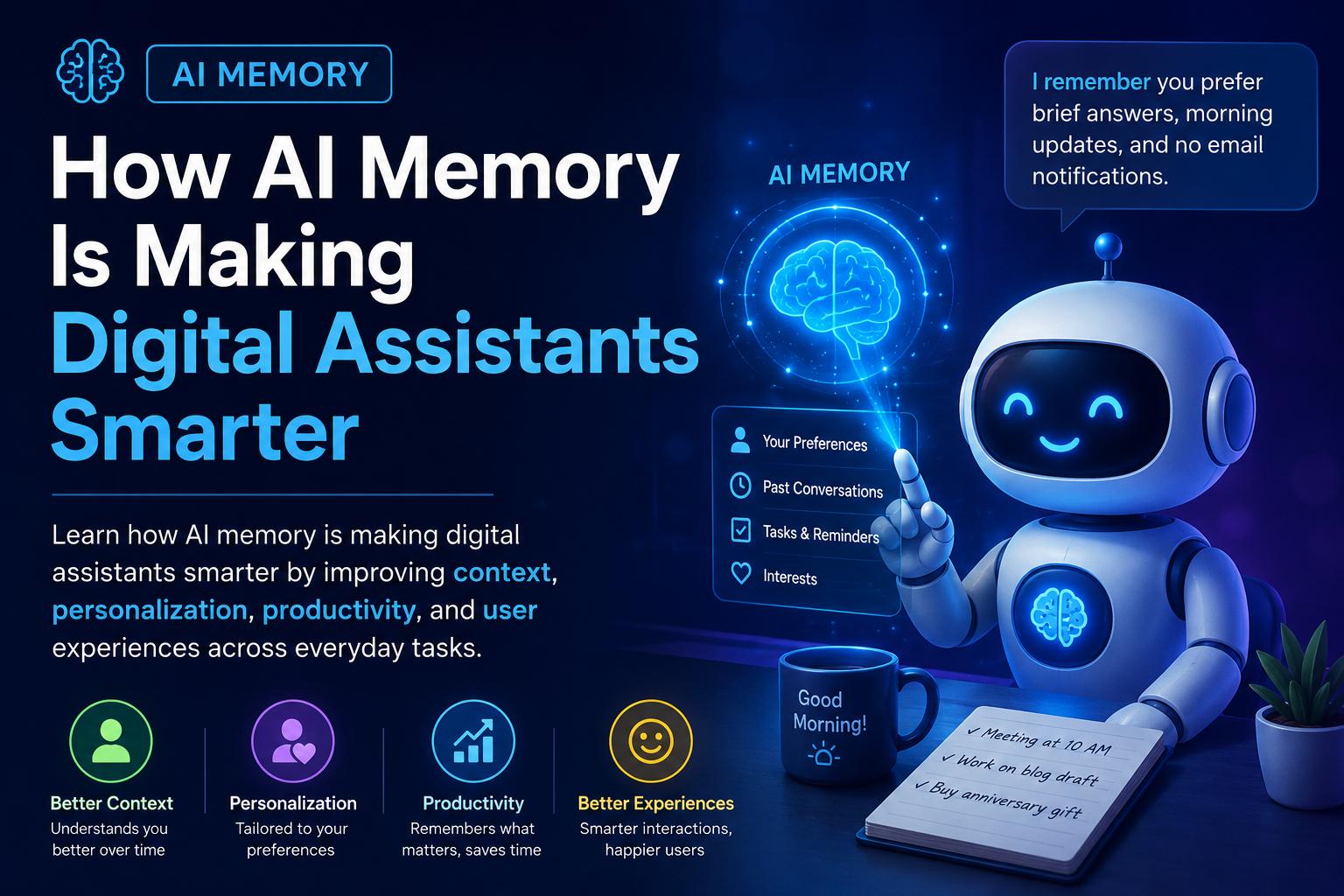
AI memory is becoming an important part of modern artificial intelligence systems and is helping digital assistants become more useful in everyday work.
The ability to remember context may not sound exciting at first. In fact, it is easy to overlook compared to flashy AI features like image generation or advanced reasoning. Yet memory is one of the most important developments in modern AI.
When an assistant remembers useful information from previous interactions, conversations become smoother, responses become more relevant, and the overall experience feels much more natural.
In many ways, memory is helping digital assistants evolve from simple tools into something closer to intelligent productivity partners.
Table of Contents
ToggleWhat Is AI Memory?
When people hear the word “memory,” they usually think about how humans remember events, conversations, experiences, or important moments from their lives.
AI memory works differently.
Several AI companies, including Open AI, are actively developing memory features that help assistants provide more personalised responses over time.
Without memory, every conversation starts from zero.
With memory, the assistant can use previous context to provide more personalized responses.
Imagine you regularly ask an AI assistant for help with software development projects. Over time, the system remembers your interests, work preferences, and common topics.
The next time you ask a technical question, it does not need to start from scratch.
That small difference can save a surprising amount of time.
Most people have experienced situations where they repeatedly explain the same details to customer support teams, software tools, or digital services. AI memory aims to reduce that frustration.
Why Older Digital Assistants Often Felt Limited
Anyone who used early voice assistants probably remembers how repetitive conversations could feel.
You asked a question.
The assistant answered.
Then the conversation effectively reset.
If you asked:
“Who is the CEO of a company?”
and followed it with:
“How old is he?”
many older systems struggled because they could not connect the two questions together.
The second question depended on context, and context was often missing.
As a result, interactions felt mechanical.
People learned to speak to digital assistants almost like they were talking to a search engine rather than having a conversation.
That limitation became one of the biggest barriers preventing assistants from feeling truly helpful.
What Makes Modern AI Feel More Natural
One reason modern AI assistants feel smarter is not necessarily because they know more information.
Often, it is because they remember more of the conversation.
Suppose someone says:
“I am planning a trip to Japan next spring.”
Ten minutes later, they ask:
“What is the best time to visit?”
Most modern AI systems can understand that the question still relates to Japan.
The user does not need to repeat everything again.
It sounds like a small improvement.
But when this happens repeatedly throughout a conversation, the experience becomes much smoother.
The assistant feels less like a tool waiting for commands and more like something that actually understands the discussion.
That feeling of continuity is one of the biggest reasons people find modern AI easier to use.
Why Memory Matters More Than People Realize
Many AI features attract attention because they are easy to demonstrate.
Image generation looks impressive.
Voice conversations feel futuristic.
Automation saves time.
Memory, however, works quietly in the background.
Most users do not notice it immediately.
What they notice is that everything feels easier.
They spend less time repeating themselves.
They receive more relevant responses.
Conversations move forward naturally.
After using a memory-enabled assistant for a while, going back to a system with no memory can feel surprisingly frustrating.
It is similar to meeting someone who forgets every previous conversation.
Technically, communication still works.
But it becomes much less efficient.
A Real Workplace Example
Think about someone who uses an AI assistant every day at work.
On the first day, they explain their role, projects, preferred communication style, and industry background.
Without memory, they may need to repeat many of those details repeatedly.
With memory, future interactions become easier.
When drafting an email, the assistant already understands the user’s preferred tone.
When creating reports, it can suggest examples that fit their industry.
When helping with presentations, it can provide recommendations based on previous work.
Over time, the experience feels more personalized.
Workplace tools such as Microsoft Copilot are already using AI capabilities to improve productivity and support daily business tasks.
Customer Support Is Becoming Smarter Too
Most people have experienced the frustration of contacting customer support multiple times about the same issue.
The conversation often starts with:
“Can you explain the problem again?”
Then the entire process repeats.
Customers rarely enjoy that experience.
AI memory is helping improve this situation.
Imagine someone contacts a company about a delayed order.
A week later, they return with another question.
Instead of starting from the beginning, the system may already remember the order details, previous discussions, and actions that were taken.
The conversation can continue naturally.
For customers, that feels like a small improvement.
For businesses handling thousands of support requests every day, it can make a huge difference.
Learning Becomes More Personalized
Education is another area where memory can have a significant impact.
Students rarely learn at exactly the same pace.
Some concepts click immediately.
Others take time.
A student learning programming, mathematics, or a new language may struggle with certain topics while progressing quickly in others.
A memory-enabled AI assistant can recognize those patterns over time.
Instead of giving the same generic explanations repeatedly, it can adapt.
Perhaps the student responds better to visual examples.
Perhaps simpler explanations work best.
Perhaps additional practice exercises are needed.
Good teachers naturally remember these things about their students.
AI memory helps digital assistants move slightly closer to that kind of personalized support.
Why Conversations Feel More Human
Human conversations depend heavily on memory.
When talking to friends, family members, or coworkers, nobody starts from the beginning every single time.
People remember previous discussions.
They build on earlier conversations.
Modern AI systems are beginning to do something similar.
If someone spends several days planning a vacation, discussing a project, or researching a major purchase, memory helps maintain continuity.
The assistant remembers important details and carries them forward.
That continuity is one reason many users describe newer AI systems as feeling more natural than earlier generations.
Not because they are human.
But because the conversation no longer resets every few minutes.
AI Memory Beyond Chatbots
When people hear about AI memory, they often think about chat assistants.
But memory is becoming important in many other technologies as well.
Smart home systems may eventually remember daily habits, preferred room temperatures, lighting settings, and routines.
Productivity software may remember how users organize projects or communicate with teams.
Personalized learning platforms may remember learning preferences and adapt lessons accordingly.
In other words, memory is becoming a foundation for many different types of intelligent systems.
Its impact extends far beyond simple conversations.
The Privacy Question
Of course, memory creates an important challenge.
The more an AI system remembers, the more people want to understand how that information is handled.
This is where privacy becomes extremely important.
Most users are comfortable with memory features only when they have clear control over them.
Questions naturally arise:
- What information is stored?
- How long is it stored?
- Who can access it?
- Can it be deleted?
These concerns are completely reasonable.
That is why responsible AI companies increasingly provide transparency tools, memory controls, and privacy settings that allow users to manage stored information.
As AI memory becomes more common, trust will become just as important as convenience.
AI Memory Is Not the Same as Human Memory
One misconception is that AI memory works like human memory.
It does not.
Humans attach emotions, experiences, and personal meaning to memories.
An AI system does not experience life.
It does not form emotional attachments to information.
Instead, it stores and retrieves information because doing so helps improve future interactions.
The distinction matters.
AI memory makes systems more useful.
It does not make them conscious.
Understanding that difference helps create more realistic expectations about what modern AI can and cannot do.
The Future of AI Memory
The role of memory in AI will almost certainly continue growing.
Future assistants may become better at understanding long-term projects, personal preferences, learning goals, and work habits.
Imagine working with an assistant that remembers:
- your communication style
- recurring projects
- professional goals
- preferred workflows
Instead of helping with isolated tasks, it could support ongoing objectives over months or even years.
That possibility is one reason technology companies are investing heavily in memory-related features.
Many experts believe memory could become one of the defining characteristics of next-generation AI assistants.
As AI systems become more capable, understanding the difference between AI assistants and AI agents is becoming increasingly important.
Why Businesses Are Paying Attention
Businesses care about memory for a simple reason.
It improves user experience.
When customers receive faster responses, more relevant recommendations, and smoother support interactions, satisfaction increases.
At the same time, employees can work more efficiently because less time is spent repeating information.
Those benefits add up quickly.
That is why memory is becoming a major focus across the AI industry.
Companies are not investing in memory simply because it sounds impressive.
They are investing because users genuinely find it useful.
Final Thoughts
Digital assistants have evolved dramatically over the past decade.
Many of the improvements people notice today are not just the result of better AI models or faster processing power.
Memory plays a major role as well.
By remembering context and using information from previous interactions, modern AI assistants can provide more relevant responses, reduce repetition, and create smoother conversations.
The result is an experience that feels more personal, more efficient, and far more useful than the digital assistants of the past.
As AI technology continues to advance, memory will likely become one of the features that users value most.
Because in the end, the smartest assistant is not always the one that knows the most.
Even as AI becomes smarter through memory and automation, many careers still rely heavily on uniquely human skills.
Sometimes it is the one that remembers what matters.
Frequently Asked Questions (FAQ)
What is AI memory?
AI memory is a feature that allows an AI system to remember useful information from previous interactions and use that context in future conversations. This helps create more personalized and relevant responses.
Do all AI assistants have memory?
No. Some AI assistants only respond based on the current conversation, while others can remember information across multiple interactions to provide a more personalized experience.
Is AI memory the same as human memory?
No. Human memory is connected to emotions, experiences, and personal understanding. AI memory simply stores and retrieves information to improve future responses and task performance.
How is AI memory used in customer support?
AI memory allows support systems to remember previous interactions, order details, and past issues. This reduces repetition and helps provide faster and more accurate assistance.
What are the benefits of AI memory?
Some key benefits include:
- More personalized interactions
- Better context awareness
- Reduced repetition
- Improved productivity
- Smarter recommendations
- More natural conversations

2 thoughts on “How AI Memory Is Making Digital Assistants Smarter”