
Artificial Intelligence is no longer a futuristic concept discussed only in research labs or science fiction movies. It has become part of everyday life for millions of people around the world.
People use AI to write emails, summarize documents, generate images, assist with coding, plan trips, and even help with medical research. Businesses are using it to improve productivity, while students are using it to learn faster and complete tasks more efficiently.
Just a few years ago, most people rarely thought about AI. Today, it is difficult to spend a day online without encountering it in some form.
As AI continues to grow, governments around the world are facing an increasingly difficult question:
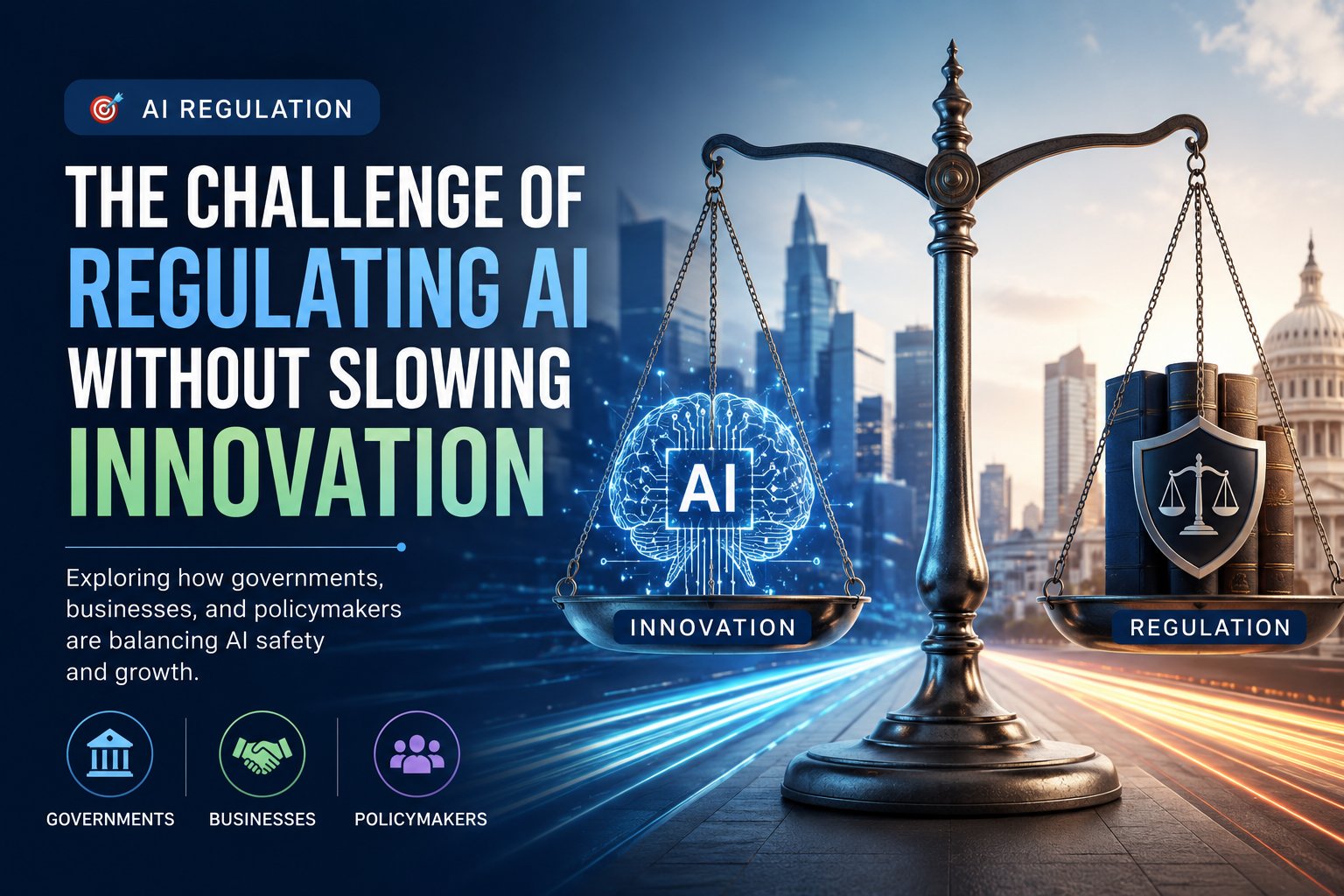
How do you regulate AI without slowing innovation?
The question sounds simple, but finding the answer is proving to be one of the biggest technology challenges of our time.
On one side are policymakers, regulators, and safety experts who want safeguards to protect people from potential risks. On the other side are technology companies and investors who worry that excessive regulation could slow progress and make innovation more difficult.
Finding the right balance is becoming a global challenge. International organizations are also studying how AI can be developed responsibly while supporting economic growth.
Table of Contents
ToggleWhy This Debate Suddenly Feels So Important
A few years ago, AI regulation was mostly a topic discussed by researchers, technology executives, and government officials.
Today, it affects almost everyone.
Students use AI tools for studying. Office workers use them for productivity. Businesses use them for automation. Content creators use them to generate images, videos, and articles.
As AI becomes more integrated into daily life, people naturally start asking difficult questions.
What happens if an AI system makes a serious mistake?
Who is responsible when AI-generated misinformation spreads online?
How should personal data be protected when AI systems learn from enormous amounts of information?
Should governments step in early or wait until problems become widespread?
These questions have moved AI regulation from a niche policy discussion into a mainstream issue.
Why AI Regulation Has Become a Global Issue
The rapid growth of AI has created enormous opportunities, but it has also raised concerns.
People worry about issues such as:
- Privacy risks
- Deepfake content
- Misinformation
- Biased decision-making
- Cybersecurity threats
- Job displacement through automation
The challenge is that AI evolves much faster than traditional industries.
A new AI model can be released in weeks or months.
New laws often take years to create.
This creates a situation where governments are constantly trying to catch up with technology that keeps moving forward.
Many policymakers admit that by the time regulations are drafted, debated, revised, and approved, the technology may already look very different.
That reality makes AI much harder to regulate than many previous technologies.
Why Innovation Matters
Supporters of lighter AI regulation often argue that innovation should not be restricted unnecessarily.
History shows that many groundbreaking technologies emerged because businesses were free to experiment and develop new ideas.
The internet, smartphones, cloud computing, and modern software ecosystems all benefited from environments that encouraged innovation.
Many experts believe AI could have an even greater impact.
AI is already helping researchers analyze complex medical data, assisting scientists in discovering new patterns, and improving efficiency across countless industries.
In healthcare, AI systems are helping identify diseases earlier.
In education, AI-powered tools are helping students receive personalized learning support.
In business, companies are automating repetitive tasks that once consumed valuable employee time.
These benefits explain why many technology companies are concerned about regulations that could unintentionally slow progress.
Their argument is simple: if innovation becomes too difficult, society could miss out on significant benefits.
Why Governments Are Paying Closer Attention
Most governments are not trying to stop AI development.
In fact, many governments openly support AI because they view it as an important driver of economic growth and global competitiveness.
The concern is not innovation itself.
The concern is what happens when powerful technology grows faster than the safeguards surrounding it.
History provides some useful lessons.
Social media platforms expanded rapidly before many governments fully understood their long-term impact. Years later, countries found themselves dealing with issues involving misinformation, online safety, privacy concerns, and platform accountability.
Many policymakers do not want to repeat the same experience with AI.
Their concern is that waiting too long could make future problems far more difficult to address.
From their perspective, creating reasonable safeguards now may be easier than trying to fix large-scale issues later.
AI Regulation Is Already Affecting Real Products
The regulation debate is no longer theoretical.
It is already influencing how AI products are built and released.
Many AI companies now perform additional safety testing before launching major features. Some organizations have introduced transparency reports, content restrictions, and safeguards designed to reduce misuse.
Governments are also paying closer attention to how AI systems collect data, make decisions, and interact with users.
As a result, companies increasingly consider regulatory concerns during product development.
This creates an interesting challenge.
Technology companies move quickly.
Governments generally move slowly.
An AI company can release a major software update overnight.
A new regulation may require months or even years of discussion.
That difference in speed is one reason the debate remains so complicated.
Why AI Is Different From Other Technologies
One reason AI regulation is particularly difficult is that AI can be used in countless different ways.
The same underlying technology may help a doctor analyze medical images, assist a teacher in creating lessons, support customer service teams, or recommend movies to viewers.
Clearly, not all of these uses carry the same level of risk.
Most people would agree that an AI system helping doctors make healthcare decisions deserves more oversight than an AI tool recommending television shows.
This creates a major challenge for regulators.
Creating one set of rules for every AI application simply does not make sense.
Instead, governments must decide which uses require stricter oversight and which should remain relatively flexible.
That is much easier said than done.
The Growing Divide Between Policymakers and Technology Companies
The debate often highlights a difference in priorities.
Technology companies tend to focus on innovation, competition, and product development.
Policymakers tend to focus on public safety, accountability, and long-term societal impact.
Neither side is necessarily wrong.
Businesses want enough flexibility to continue developing new technologies.
Governments want confidence that powerful systems are being used responsibly.
The challenge is that both goals are important.
A world with no innovation would limit progress.
A world with no safeguards could create serious risks.
The real question is how to support both at the same time.
Donald Trump Compromise Highlights the Core Challenge
One recent example that attracted attention involved discussions surrounding AI regulation in the United States.
Reports indicated that Trump supported a compromise approach intended to satisfy both technology companies and members of his political base.
The situation reflected a challenge governments around the world are facing.
Technology companies generally preferred a lighter regulatory approach that would allow AI development to continue at a rapid pace.
At the same time, some policymakers and public-interest groups argued that stronger safeguards were necessary to address concerns involving privacy, misinformation, deepfakes, and potential job disruption.
The compromise attempted to balance those competing priorities rather than fully favoring one side.
Whether such approaches will prove successful in the long term remains uncertain.
However, the debate highlights an important reality.
Almost everyone agrees AI is important.
The disagreement begins when deciding how much oversight is appropriate.
The Risk of Overregulation
One of the biggest concerns raised by the technology industry is overregulation.
Large technology companies often have extensive legal teams and significant financial resources.
Smaller companies and startups usually do not.
Imagine a small startup developing an AI tool that helps students learn mathematics more effectively.
If compliance requirements become too expensive or complicated, that startup may never reach the market.
As a result, innovation could become concentrated among only the largest organizations.
Many experts worry this would reduce competition and limit future breakthroughs.
Good regulations should protect people without making innovation impossible for smaller businesses.
The Risk of Underregulation
At the same time, having too few rules also creates risks.
Without clear standards, organizations may deploy AI systems without sufficient testing, accountability, or transparency.
This could increase the likelihood of errors, bias, privacy concerns, and misuse.
Imagine an AI system being used to help make decisions about employment, loans, or healthcare.
Most people would want some assurance that those decisions are being made fairly and responsibly.
Public trust matters.
If people repeatedly encounter harmful or unreliable AI systems, confidence in the technology may decline.
Ironically, a lack of regulation could eventually slow innovation as well because people may become less willing to adopt AI tools.
What Does a Balanced Approach Actually Look Like?
Many experts believe the best solution lies somewhere in the middle.
The goal is not choosing between innovation and regulation.
The goal is finding smart regulation.
For example, an AI chatbot helping someone write a marketing email probably does not require the same oversight as an AI system involved in medical diagnoses or financial decisions.
A balanced framework focuses more attention on higher-risk applications while allowing lower-risk innovation to continue moving quickly.
Such an approach may include transparency requirements, privacy protections, accountability standards, and independent testing for critical systems.
At the same time, regulations must remain flexible enough to adapt as technology changes.
This balance is difficult to achieve, but many policymakers increasingly see it as the most practical path forward.
International Differences Make Everything More Complicated
AI companies often operate globally, but regulations do not.
Different countries have different priorities, legal systems, and approaches to technology policy.
Some regions place greater emphasis on privacy and consumer protection.
Others focus more heavily on innovation and economic competitiveness.
As a result, companies may find themselves navigating multiple regulatory frameworks at the same time.
What is allowed in one country may face additional restrictions in another.
This creates additional complexity for businesses developing AI products for global markets.
International cooperation will likely become increasingly important as AI continues to evolve.
What Ordinary People Really Want
One interesting aspect of this debate is that most people are not firmly on one side or the other.
Most people want both innovation and protection.
They want AI to help doctors discover diseases faster. At the same time, many workers are wondering which careers will continue to rely on uniquely human skills.
They want students to have better learning tools.
They want businesses to become more productive.
But they also want privacy.
They want accountability.
They want safeguards against misuse.
In reality, most people are not choosing between innovation and regulation.
They are hoping society can achieve both.
The Future of AI Regulation
As AI becomes more powerful and more deeply integrated into everyday life, discussions about regulation will only become more important.
Future AI systems may become increasingly capable, autonomous, and influential.
Governments, businesses, researchers, and the public will all play a role in shaping how these systems are governed.
The most successful policies will likely be those that remain flexible enough to adapt to technological change while still addressing legitimate concerns.
Achieving that balance will not be easy.
But it may become one of the defining policy challenges of the digital age.
Conclusion
Artificial Intelligence has enormous potential to improve lives, increase productivity, and accelerate innovation across countless industries.
At the same time, its growing influence raises important questions about privacy, accountability, safety, and public trust.
This is why the debate over AI regulation continues to intensify around the world.
Governments want safeguards.
Technology companies want room to innovate.
Citizens want both progress and protection.
The challenge is not choosing one over the other.
The challenge is finding a path that allows innovation to continue while ensuring AI is developed responsibly.
As recent debates, including the Trump compromise on AI regulation, have shown, there are no simple answers.
Yet the decisions made today could shape how artificial intelligence influences society for decades to come.
FAQ Section
What is AI regulation?
AI regulation refers to the laws, policies, and guidelines created by governments and regulatory bodies to ensure artificial intelligence is developed and used safely, responsibly, and ethically.
Why is AI regulation important?
AI regulation helps address concerns related to privacy, misinformation, bias, cybersecurity, accountability, and public safety while encouraging responsible innovation.
What are the biggest risks associated with AI?
Some commonly discussed AI risks include:
- Deepfake content
- Misinformation
- Privacy concerns
- Biased decision-making
- Cybersecurity threats
- Job displacement through automation
How is AI regulation different from regulating other technologies?
AI can be used across many industries, from healthcare and finance to education and entertainment. Because the risks vary depending on the application, creating a single set of rules for all AI systems is challenging.
Will AI regulation become a global issue?
Yes. Since many AI companies operate internationally, governments will likely need greater cooperation and coordination to create effective regulatory standards across different regions and markets.

One thought on “The Challenge of Regulating AI Without Slowing Innovation”