
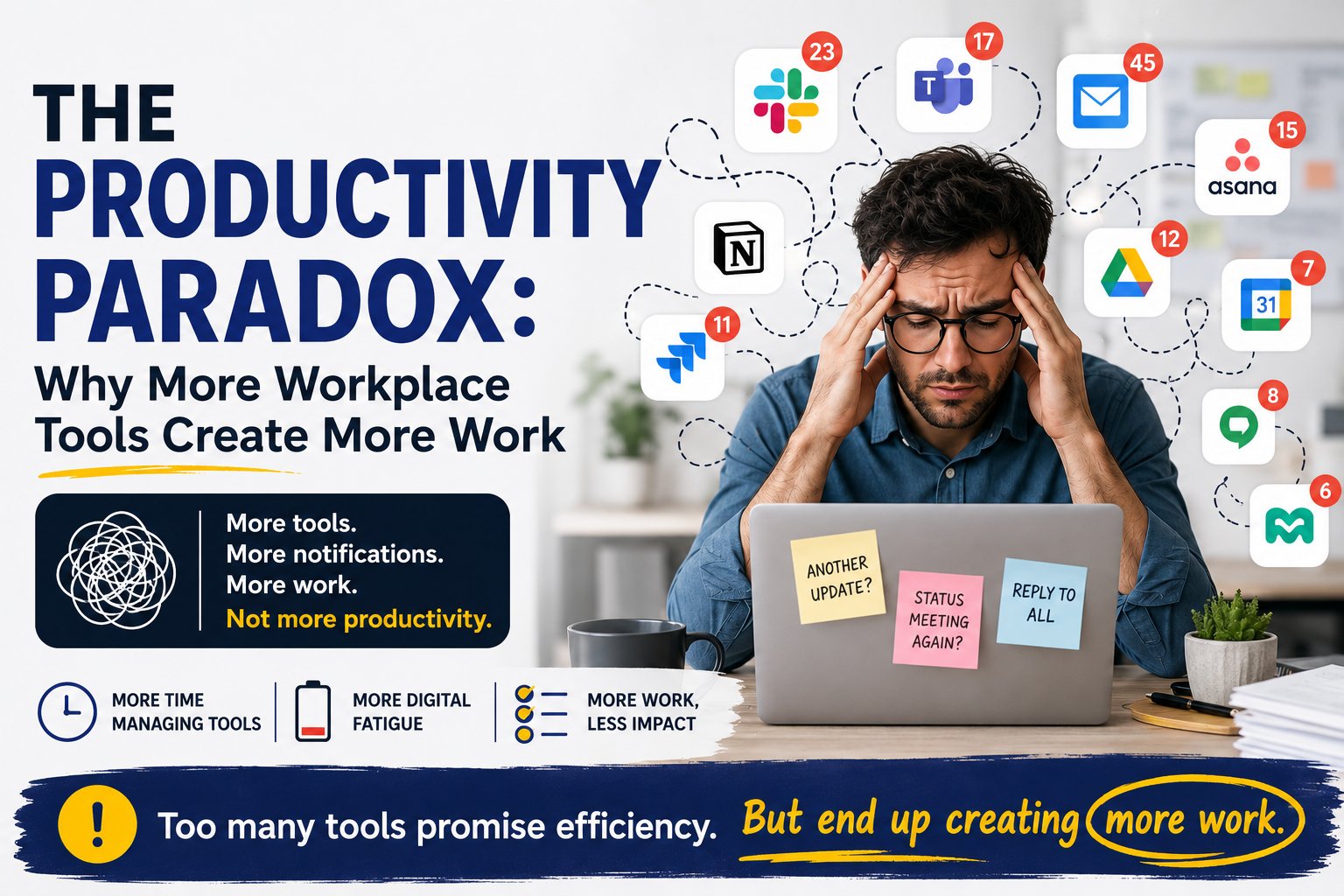
Modern workplaces have more technology than ever before.
Employees can communicate instantly, collaborate from anywhere, automate repetitive tasks, and access information within seconds. On paper, all these advancements should make work easier and productivity higher.
Yet many workers feel the opposite.
Despite having access to dozens of productivity apps, communication platforms, project management systems, and AI-powered tools, people often end the day feeling busy but not particularly productive.
This contradiction has become known as the productivity paradox.
The idea is simple: the more workplace tools organisations introduce, the more work employees sometimes create for themselves.
Instead of saving time, technology can occasionally consume it.
Understanding why this happens has become increasingly important as companies continue investing in digital workplace solutions.
Table of Contents
ToggleWhen Being Busy Is Not the Same as Being Productive
Most office workers recognize this situation immediately.
You start the morning with a clear plan. Perhaps you want to finish a report, prepare a presentation, or complete an important project before the end of the day.
Then reality arrives.
A message appears in the team chat. An email notification pops up. A meeting invitation lands in your calendar. A project management platform requires an update. Someone tags you in a shared document.
Before long, half the day has disappeared.
You have been active the entire time, yet the task you originally planned to complete remains unfinished.
This experience has become surprisingly common in modern workplaces.
Many employees are not struggling because they lack tools. They are struggling because they have too many competing for their attention.
How Workplace Software Expanded So Quickly
Over the past decade, businesses have embraced digital transformation at an incredible pace.
Companies adopted messaging platforms to improve communication. Project management software helped organize tasks. Video conferencing tools supported remote work. Cloud platforms made collaboration easier.
Each new tool solved a specific problem.
The issue is that organizations rarely remove old systems when they introduce new ones.
As a result, employees often find themselves working across multiple platforms throughout the day.
A typical worker may check email, respond to team messages, update project boards, join video meetings, review shared documents, and track progress in several different systems.
None of these activities are harmful individually.
The challenge comes from constantly switching between them.
Research has repeatedly shown that context switching reduces focus and efficiency. Even small interruptions can break concentration and make it harder to return to meaningful work.
When this happens dozens of times every day, the impact becomes significant.
The Hidden Cost of Constant Notifications
Notifications were originally designed to keep people informed.
Today, they are one of the biggest sources of workplace distraction.
Every alert creates a small decision.
Should I respond now?
Can this wait?
Is this important?
Most people underestimate how much mental energy these decisions consume.
A notification might only take a few seconds to read, but recovering focus afterward often takes much longer.
Many employees have experienced days where they spend hours responding to messages, attending meetings, and updating software platforms, only to realize they have made very little progress on their most important work.
Being occupied is not always the same thing as being productive.
The two are often confused in modern workplaces.
The Rise of Digital Workplace Fatigue
Technology was supposed to reduce workplace stress.
In some cases, it has done exactly that.
In others, it has created a new challenge.
Digital workplace fatigue.
Employees today are expected to monitor multiple communication channels, manage various software systems, and stay connected throughout the workday.
The pressure is not always obvious.
No single tool feels overwhelming.
However, when ten different tools all require attention, the cumulative effect can become exhausting.
Many workers describe feeling mentally drained before they have even started their most important tasks.
The issue is not necessarily the tools themselves.
It is the volume of information competing for attention.
Why the Productivity Paradox Keeps Getting Worse
One reason the productivity paradox continues is that adding technology feels like progress.
When a business introduces new software, there is usually excitement.
The platform promises better collaboration, improved communication, faster workflows, or increased efficiency.
Removing software rarely generates the same enthusiasm.
As a result, organizations often continue adding solutions without asking an important question:
Do we actually need another tool?
In many cases, the problem is not a lack of technology.
It is a lack of simplification.
Some of the most productive teams are not using the largest number of applications.
They are using a smaller collection of tools extremely well.
AI Is Making the Conversation Even More Interesting
Artificial intelligence has become the latest addition to the workplace technology landscape.
Companies are introducing AI assistants, AI-powered search tools, meeting summarises, automated reporting systems, and intelligent workflow platforms.
Studies suggest AI could significantly improve productivity when implemented effectively.
They can reduce repetitive work, improve efficiency, and help employees complete tasks faster.
However, there is also a risk.
Some organisations are adding AI tools without reducing existing complexity.
Instead of replacing older workflows, AI sometimes becomes another layer on top of them.
Employees may find themselves managing traditional software while also learning new AI platforms.
Many organizations are also exploring the differences between AI assistants and AI agents as automation becomes more advanced.
Ironically, a tool designed to simplify work can sometimes create additional processes if implemented poorly.
This challenge is becoming increasingly relevant as businesses race to adopt AI technologies.
The recent debate surrounding AI regulation, including discussions involving Trump, technology companies, and policymakers, highlights a broader trend. Organisations are eager to embrace AI innovation, but many are still figuring out how to integrate these systems effectively without creating new complications.
The same principle applies inside workplaces.
Technology only creates value when it genuinely reduces friction.
Adding complexity rarely improves productivity.
The Meeting Problem
Many workplace tools are designed to improve communication.
Unfortunately, they sometimes create more communication than necessary.
A quick question becomes a scheduled meeting.
A meeting generates follow-up messages.
The messages lead to another discussion.
The discussion results in another meeting.
Employees often joke that they spend more time talking about work than actually doing it.
While this may be an exaggeration, it reflects a genuine frustration.
Communication tools are valuable, but excessive communication can become a productivity problem of its own.
What Productive Companies Do Differently
Highly productive organizations often take a different approach.
Instead of constantly adding new software, they focus on reducing unnecessary complexity.
They regularly evaluate which tools employees actually use.
They eliminate overlapping systems.
They simplify workflows whenever possible.
Most importantly, they recognise that attention is a limited resource.
Protecting employee focus becomes a priority.
Some companies even encourage notification-free work periods, allowing employees to concentrate on important projects without constant interruptions.
These practices may seem simple, but they often produce significant results.
Questions Businesses Should Ask Before Adding Another Tool
Before introducing new workplace software, leaders should ask a few practical questions.
Will this tool replace an existing system or simply add another layer?
Does it solve a genuine problem?
How much training will employees require?
Will it reduce workload or create additional administrative tasks?
Sometimes the best productivity decision is not adopting a new platform.
Sometimes it is simplifying what already exists.
Solving the Productivity Paradox Through Simplicity
The productivity paradox is not really about technology.
It is about attention.
Most employees do not need more dashboards to monitor, more apps to open, or more notifications competing for their focus.
They need uninterrupted time to do meaningful work.
Technology should support that goal, not interfere with it.
The companies that understand this will likely have a significant advantage in the years ahead.
While others continue searching for the next productivity tool, successful organizations may focus on something much harder to achieve.
Simplicity.
In a world overflowing with workplace software, simplicity may become the most valuable productivity strategy of all.
Conclusion
Workplace tools are not the enemy of productivity.
In many cases, they make collaboration, communication, and innovation possible.
The challenge arises when organisations keep adding technology without considering its cumulative impact on employees.
More tools do not automatically mean better results.
Sometimes the opposite is true.
Global business leaders continue to explore how technology can improve productivity without overwhelming employees.
The future of workplace productivity may not depend on finding the next revolutionary platform.
It may depend on learning when enough is enough.
Organisations that strike that balance will be better positioned to improve productivity, reduce employee fatigue, and create work environments where people can focus on what truly matters.
FAQ Section
What is the productivity paradox?
The productivity paradox refers to the situation where businesses adopt more workplace tools and technology to improve efficiency, but employees often end up feeling less productive due to distractions, tool overload, and constant context switching.
What is digital workplace fatigue?
Digital workplace fatigue is the mental exhaustion employees experience from constantly interacting with multiple software platforms, communication channels, notifications, and digital workflows throughout the workday.
Can AI tools improve workplace productivity?
Yes. AI tools can automate repetitive tasks, summarize meetings, generate reports, and improve efficiency. However, if organizations add AI tools without simplifying existing workflows, they may create additional complexity instead of reducing it.
Why is focus important for productivity?
Focus allows employees to complete meaningful work without interruptions. Frequent distractions and context switching can reduce efficiency, increase mistakes, and make work feel more stressful.

One thought on “The Productivity Paradox: Why More Workplace Tools Create More Work”