
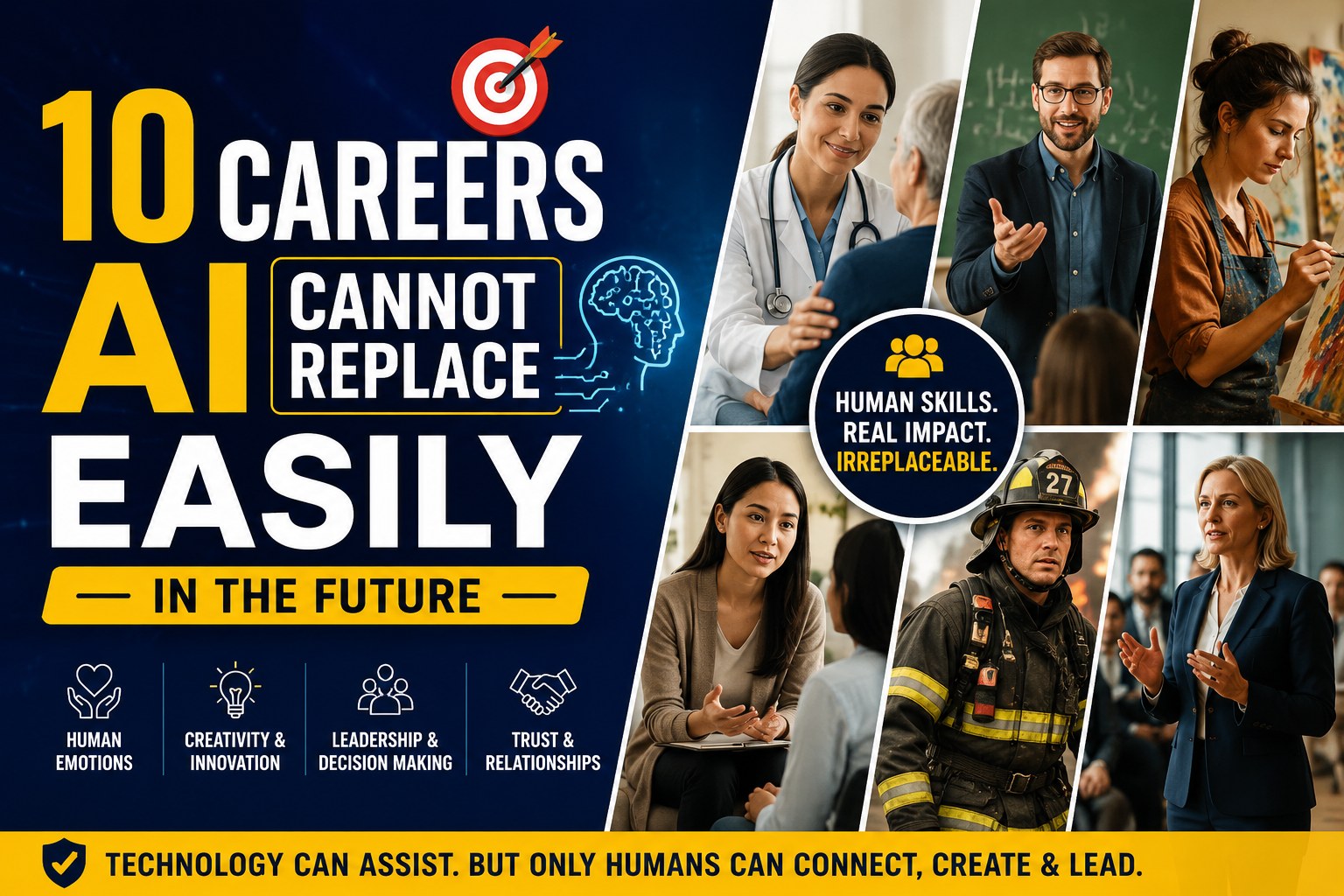
Artificial Intelligence is improving faster than most people expected.
Just a few years ago, AI tools were mostly experimental. Now they can write emails, generate images, summarise reports, create code, answer customer questions, and even automate parts of office work.
Because of this, many people have started worrying about jobs.
Students are unsure which careers are safe anymore. Office employees wonder whether automation will eventually replace them. Social media discussions about “AI taking over everything” have made the fear even stronger.
But real life is usually more complicated than internet predictions.
AI is already being used widely for automation, pattern recognition, and repetitive tasks across industries, as explained by IBM’s overview of artificial intelligence. What it still struggles with are the deeply human parts of work empathy, leadership, emotional understanding, trust, adaptability, and handling unpredictable situations.
And that matters more than many people realise.
In fact, some careers may become even more valuable as AI grows.
Table of Contents
ToggleTeachers and Mentors
Most people can remember at least one teacher who genuinely changed their confidence or direction in life.
Usually it was not because of a textbook lesson alone.
Sometimes it was encouragement during a difficult year. Sometimes it was simply a teacher noticing when a student was struggling quietly.
AI can explain formulas and grammar quickly, but classrooms are emotional environments, not just information systems.
Some students lose confidence very easily. Others stop participating without saying why. Good teachers often notice small changes before anyone else does.
That kind of awareness comes from human observation, not just data.
And honestly, many students do not just need information anymore, they need motivation, discipline, confidence, and guidance.
Those things are harder to automate than people think.
Psychologists and Counsellors
Mental health support depends heavily on trust.
People dealing with anxiety, grief, loneliness, or emotional trauma usually do not want perfectly optimised responses. They want to feel understood.
That difference matters.
AI chatbots may become useful for basic support or mental wellness guidance, but therapy itself involves emotional nuance that goes far beyond words alone.
A counsellor notices pauses, tone changes, body language, hesitation, emotional avoidance, small human details that machines still struggle to truly understand.
And in difficult emotional moments, many people simply feel safer talking to another person.
As stress and burnout continue increasing globally, mental health professionals may actually become more important in the future, not less.
Doctors and Healthcare Workers
Healthcare is one of the clearest examples of where human connection still matters heavily.
A patient sitting in a hospital room after hearing difficult news usually needs more than medical information. They need reassurance. Sometimes they simply need another human being who understands fear and uncertainty.
AI can already help doctors analyze scans faster and organize medical data more efficiently. Hospitals will absolutely use more AI tools in the future.
But healthcare decisions are rarely just about numbers on a screen.
Two patients with the exact same illness may react completely differently emotionally. One person stays calm while another becomes overwhelmed. Doctors and nurses deal with these situations every day.
Anyone who has spent time inside hospitals already knows this.
People remember how healthcare workers treated them during stressful moments. That emotional side of care is difficult to automate.
AI will likely become a powerful assistant in medicine, but patients will still want real humans making critical decisions and offering support.
Skilled Trade Workers
A lot of people underestimate skilled trade jobs until something breaks unexpectedly.
Electricians, mechanics, plumbers, repair technicians, these careers involve practical problem-solving in unpredictable environments.
That unpredictability is important.
Factories are easier to automate because conditions stay controlled. Real homes, buildings, and damaged systems are much messier.
An experienced mechanic, for example, often relies on instinct developed over years of hands-on work. Sometimes the issue is not obvious from diagnostic tools alone.
The same applies to electricians working under difficult or unsafe conditions where quick judgement matters.
These jobs involve movement, adaptation, observation, and physical interaction with constantly changing environments.
That is much harder for AI and robotics to fully replace than many people assume.
Business Leaders and Managers
Leadership is one of those things that sounds simple until things start going wrong.
Managing people during stable periods is already difficult. Managing people during stress, layoffs, financial pressure, or project failure is even harder.
AI can analyze business data quickly, but leadership involves emotions, communication, accountability, and difficult conversations.
Employees do not just want instructions from managers. They want clarity, trust, confidence, and sometimes reassurance.
A spreadsheet cannot calm an anxious team during uncertainty.
And most workplaces are far more emotional than they appear from the outside.
That human side of leadership still matters heavily.
Creative Professionals
AI tools from companies like OpenAI can already generate images, videos, code, and written content within seconds.
That part surprises people.
But creating content and creating something emotionally meaningful are not always the same thing.
Human creativity usually comes from experience, heartbreak, memories, struggles, relationships, culture, identity, personal observations.
People connect deeply with stories when they feel real.
A filmmaker talking about personal loss, a writer describing childhood memories, or a musician expressing emotion through lyrics creates something audiences emotionally recognize.
AI may imitate creative patterns, but human experiences still shape the strongest art.
And interestingly, as AI-generated content becomes more common online, genuinely human creativity may actually become more valuable because people increasingly look for authenticity.
Lawyers and Legal Professionals
Law is not only about memorising rules.
A major part of legal work involves interpretation, negotiation, ethics, and understanding human situations that are rarely straightforward.
AI can help organise documents or summarise legal information faster, and many firms are already using it for support tasks.
But courtroom decisions, sensitive disputes, and negotiations often involve emotional, social, and cultural complexity.
For example, family-related legal cases are rarely just technical problems. Emotions, relationships, and personal history influence outcomes heavily.
That human complexity is difficult to reduce into simple automation.
Emergency Response Workers
Emergency response is one of the hardest environments to automate completely.
Firefighters, rescue workers, and emergency teams operate in unpredictable conditions where situations change within seconds.
Smoke spreads unexpectedly. Buildings become unstable. Natural disasters create chaos very quickly.
These jobs depend heavily on adaptability, courage, fast decision-making, and teamwork under pressure.
Technology will absolutely help emergency teams with mapping, monitoring, and communication tools. But human instinct still plays a massive role in dangerous situations.
And realistically, during emergencies, most people still trust human res ponders more than automated systems.
Engineers and Technical Problem Solvers
AI is already becoming useful in engineering and software development.
It can assist with coding, simulations, calculations, and repetitive technical work.
Still, real engineering problems usually involve much more than formulas.
Engineers working on aircraft systems, transportation safety, infrastructure, or medical equipment deal with situations where even small mistakes can create serious consequences.
In those moments, human judgment matters.
Experienced engineers also think beyond technical outputs. They consider long-term safety, user experience, unexpected risks, and practical limitations.
AI can support the process, but humans still carry the responsibility.
Human Resource Professionals
Hiring people is much more complicated than scanning resumes.
Two candidates may look almost identical on paper while feeling completely different during conversations.
One person may communicate naturally, handle pressure calmly, and fit the company culture better. Another may struggle in team environments despite having strong technical skills.
Human resource professionals often notice these subtle differences.
They also deal with workplace conflict, employee stress, communication issues, and team dynamics, areas where emotional intelligence matters heavily.
AI can assist with filtering applications or organizing hiring data, but people management still depends strongly on human understanding.
The Real Future of Jobs
A lot of people imagine a future where AI completely replaces human workers everywhere.
Reality will probably look far less dramatic.
Many companies are already moving from basic AI assistants toward more advanced AI agents that can handle workflows with less human involvement.
Office workers are also increasingly using tools like Microsoft Copilot to automate repetitive productivity tasks.
Engineers may use automation software while humans approve final systems.
Teachers may use AI-generated learning tools while still guiding students emotionally and socially.
The future is probably not “humans versus AI.”
It is more likely humans working alongside increasingly powerful tools.
Human Skills May Become Even More Valuable
Ironically, as AI handles more repetitive tasks, human skills may become even more important.
Communication, emotional intelligence, leadership, adaptability, creativity, and critical thinking are difficult to automate fully because they depend heavily on context and human behavior.
Technology changes quickly.
Human nature changes much more slowly.
That is why careers involving trust, relationships, responsibility, and emotional understanding may continue staying valuable even in highly automated industries.
Final Thoughts
Artificial Intelligence will absolutely reshape the job market.
Some repetitive jobs will change significantly. Certain tasks may disappear completely.
But many careers still depend heavily on things humans naturally do better understanding emotions, building trust, adapting to uncertainty, solving messy real-world problems, and supporting other people during difficult moments.
A teacher motivating a struggling student, a doctor comforting a worried patient, or a firefighter making split-second decisions inside dangerous conditions involves something deeper than automation.
And that human element is still incredibly difficult to replace.
The future may not belong to people who avoid AI completely.
More likely, it will belong to people who learn how to work with AI while strengthening the skills that technology still cannot easily copy.
FAQ Section
What jobs can AI not replace easily?
Jobs involving emotional intelligence, creativity, leadership, human interaction, and unpredictable problem-solving are harder for AI to replace completely.
Will AI replace teachers in the future?
AI may assist teachers with learning tools and automation, but human teachers remain important for motivation, mentorship, emotional understanding, and classroom guidance.
Which careers are safest from AI automation?
Careers involving leadership, counseling, healthcare, skilled trades, emergency response, and creative work are generally considered safer from full AI replacement.
Are skilled trade jobs safe from AI?
Many skilled trade jobs like electricians, plumbers, mechanics, and repair technicians are difficult to automate because they involve physical work in unpredictable environments.
What skills will become more valuable in the AI era?
Human skills like communication, emotional intelligence, adaptability, leadership, creativity, and critical thinking will likely become even more valuable as AI grows.

One thought on “10 Careers AI Cannot Replace Easily in the Future”